
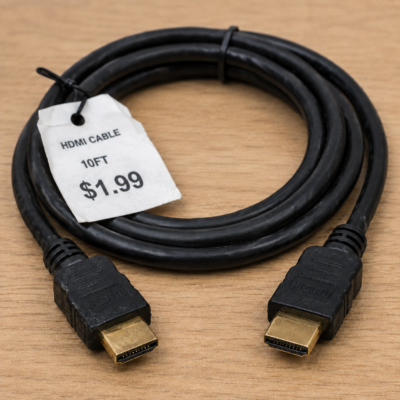
HDMI cables often represent a small percentage of an audio-visual project’s total equipment budget and, unfortunately, that makes them an easy place to reduce costs. When two cables appear to support the same resolution and signal performance specifications, choosing the less expensive option can seem like responsible purchasing.
However, for professional integrators (and ultimately the clients they serve), the invoice price is only a fraction of the cable’s real cost.
An HDMI cable installed behind a display, inside a wall or above a finished ceiling is not simply an accessory. It becomes part of the system infrastructure. If that cable is difficult to install, inconsistent at higher bandwidths or prone to premature manufacturing failure, the resulting labor and service costs can quickly exceed the original savings.
A cheap HDMI cable does not necessarily eliminate cost. It often transfers cost from the product itself to the integrator.
>
Understanding the Difference Between Project Cost and Total Installed Cost
Project cost is typically calculated as the price of the products plus the labor required to install them. When an integrator quotes a project, the proposal commonly presents either a single price for installed bill of materials or a line-item breakdown separating the bill of material and labor.
Total installed cost takes a more holistic approach. It includes the cable price, installation labor, commissioning time, future service exposure, the cost and difficulty of replacement and potential reputational risk.
The cable price is known before the project begins. The other costs may not appear until installation, system commissioning or months after the customer takes ownership.
This is what makes inexpensive HDMI cables deceptively risky. Saving several dollars on a cable may look good on a bill of materials, but one troubleshooting visit can erase the savings generated across dozens of projects.
A technician returning to a jobsite is not only generating vehicle and labor costs. That technician is also unavailable for a new installation, a billable service appointment or another revenue-producing activity. The integrator may also need to coordinate access with the customer, remove a display, open a rack or work around finished construction.
The result is a cable that was inexpensive to purchase but expensive to own.
>
Cheap Cables Shift Quality Control to the Jobsite
 One of the most important differences between consumer-grade and professional-grade connectivity is where quality control occurs.
With a well-engineered cable, testing and quality assurance occur during design and manufacturing. With an inconsistently manufactured cable, the integrator effectively becomes the final quality-control department.
Worse, the testing happens at the most expensive possible location: the jobsite.
A questionable cable may appear functional during an initial power-up. It may pass a lower-bandwidth signal but become unstable when the system is configured for higher frame rates, greater color depth, HDR or other advanced features. It may also work with one source and display combination but struggle when connected through an AVR, matrix switcher or other intermediary device.
And, unfortunately, the symptoms are not always obvious. Intermittent signal dropouts, video artifacts, audio interruptions and extended synchronization times can send technicians down a lengthy troubleshooting path. Firmware, device settings, EDID, HDCP, source configuration and display compatibility may all be investigated before the cable is identified as the problem.
>
Bandwidth Claims Are Only Part of the Story
Modern HDMI systems place significant demands on the physical cable. Certified cables must meet defined performance requirements and carry the appropriate certification label. Certification is not, however, the only consideration for a professional installation.
HDMI certification does not necessarily evaluate every physical characteristic that affects jobsite performance, including connector durability, cable flexibility, strain relief, retention force and resistance to installation damage. Kordz, a core partner of Future Ready Solutions, specifically emphasizes that professional reliability requires attention to these mechanical and construction details in addition to electrical performance.
A cable can therefore meet a bandwidth requirement yet still be poorly suited to the way an integrator needs to route, connect and service it.
>
Some HDMI Cables Fail Economically Before They Fail Electrically
An HDMI cable does not need to stop transmitting a signal to cost an integrator money.
A stiff cable can take longer to route through a rack or behind a low-profile display. An oversized connector may not fit through conduit or within a recessed back box. Inadequate strain relief can increase stress at the connector and device port when the cable is bent. Poor connector tolerances can create a connection that is either too loose or unnecessarily difficult to insert.
These are not minor inconveniences when multiplied across an entire installation team.
Consider a technician building a rack with a dozen or more HDMI connections. If each cable is unnecessarily long, difficult to dress or prone to becoming disconnected, the rack takes longer to assemble and is harder to service. Excess cable can also obstruct airflow, increase congestion and make tracing connections more difficult.
The same principle applies behind displays. A thick, rigid cable will place strain on the HDMI port or prevent the display from sitting properly against the wall. Solving the problem may require in-line adapters, a deeper back box or additional labor.
A professional cable should make installation more predictable… it should not force the technician to engineer around the cable.
>
The Reputation Cost Is More Difficult to Measure
Customers rarely distinguish between a cable problem and a system problem.
When a television occasionally loses its picture, a conference room display fails before an important presentation or a home theater produces intermittent audio, the customer does not blame the cable manufacturer. The customer calls the integrator.
Repeated connectivity problems undermine confidence in the entire installation, even when every other component was designed and programmed correctly. The system may include premium displays, sophisticated control, high-performance audio and professional installation, but a single unreliable connection can define the customer’s experience.
That creates a cost beyond the immediate service visit. It can affect referrals, reviews, future upgrades and the customer’s willingness to recommend the integrator. Reliable connectivity protects more than the signal. It protects the relationship.
>
How Kordz Reduces HDMI Installation Risk
Kordz approaches HDMI cabling as an engineered system component rather than a commodity accessory. Its product families are designed around professional installation requirements such as predictable performance, flexible routing, compact connectors, secure retention and application-specific construction.
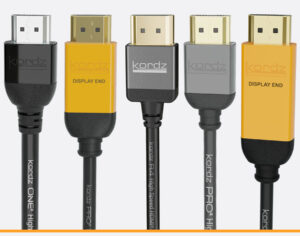 The Kordz PRO4 Passive HDMI Cable supports 48Gbps signal transmission in lengths up to 9 meters. It combines a flexible, fire-rated cable with compact connectors, 1-kilogram connector retention and individual production testing.
For longer distances, the Kordz PRO4 Active Optical HDMI Cable supports 48Gbps connectivity from 7.5 meters to 100 meters. It is individually tested, DPL Labs certified and constructed with a 4.7-millimeter cable diameter and a 20-kilogram pull-force rating for demanding installation conditions.
For short connections within equipment racks, the Kordz R.4 HDMI Cable is designed around precise cable lengths, compact routing, secure retention, airflow and mechanical stability. It supports 48Gbps performance and is certified to the DPL Enhanced 48Gbps Reference Standard.
For truly commodity installations, the Kordz OneV2 Series delivers 18Gbps 4K HDMI up to 5 meters. They are purpose built for economical, high-volume installations.
Future Ready Solutions and Kordz allow integrators to standardize on a consistent connectivity platform without forcing one cable design into every environment.
>
Standardization Can Be as Valuable as Cable Performance
Using a consistent professional HDMI platform such as Kordz creates operational benefits beyond the performance of an individual cable.
Technicians become familiar with connector dimensions, cable flexibility, labeling and routing behavior. Estimators can specify products with greater confidence. Purchasing teams can reduce the number of unknown brands and unverified substitutions entering the organization. Service technicians know what was installed and what replacement products are appropriate.
Standardization also makes project outcomes easier to repeat.
This matters because profitability does not come only from completing one successful installation. It comes from developing processes that produce successful installations consistently across multiple technicians, projects and customers. Simply put: predictability has value.
>
The Most Economical Cable Is the One You Do Not Have to Replace
Selecting an HDMI cable solely by unit price ignores where the greatest project costs actually occur.
The cable is purchased once, but labor is paid every time the cable must be installed, diagnosed or replaced. And perhaps most importantly, customer confidence must be rebuilt every time the system behaves unpredictably.
This is why professional connectivity must be viewed as an investment in risk reduction rather than an opportunity for minor material savings.
Future Ready Solutions offers the Kordz HDMI product line along with the technical expertise needed to match bandwidth, distance and cable construction to the application. By specifying purpose-engineered connectivity at the beginning of a project, integrators can complete installations more efficiently, reduce preventable service calls and deliver the predictable performance their customers expect.
A cheap HDMI cable may lower the initial bill of materials. A professionally engineered HDMI cable helps protect the profitability of the entire project.