
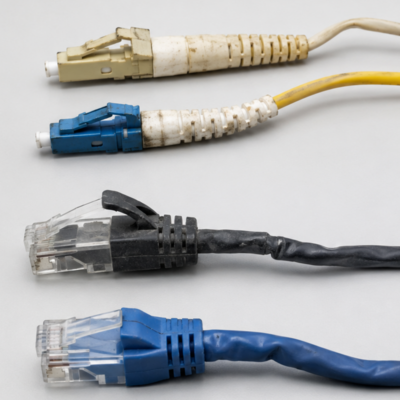
Patch cables are often treated as an afterthought. They are typically a small and inexpensive part of integrations compared to switches, displays, access points, AV-over-IP systems, security cameras and other signal distribution hardware. Plus, they are easy to replace when something goes wrong.
That mindset is exactly why cheap patch cables create so many problems.
Whether you are installing fiber optic patch cords in a commercial network, connecting AV equipment in a rack or using twisted pair Ethernet patch cables distributed throughout the home, the quality of the patch cable directly affects performance, reliability and long-term serviceability.
A low-cost patch cable may seem like a harmless way to save money, but in many systems it becomes the weakest link.
>
>
Patch Cables Are Not Just Accessories
Patch cables are part of the active signal path. Every packet, video stream, control command and electrical or optical signal must pass through them.
In a typical installation, patch cables connect network switches, patch panels and structured wiring panels, routers and firewalls, wireless access points, AV-over-IP encoders and decoders, security cameras and NVRs, media converters and transceivers, and home theater and automation systems. All of these nodes depend on clean connectivity to operate (and interoperate) correctly.
When a patch cable is poorly manufactured, damaged easily or built with questionable materials, the entire system can suffer.
Cheap cables may work on day one. The real problem is what happens after installation, during testing, during rack service, after repeated movement or when the network is pushed to higher speeds.
>
Common Problems with Cheap Fiber Patch Cables
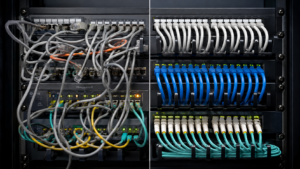 Fiber optic patch cords require precision. Small flaws in manufacturing, polishing, geometry or cleanliness can create signal loss, intermittent issues or long-term reliability problems. Below are common problems associated with lower-cost fiber patch cables.
Poor Connector End-Face Quality. The connector end-face is one of the most important parts of a fiber patch cord. If the end-face is poorly polished, scratched, contaminated or out of spec, it can cause high insertion loss, reflectance issues and unstable performance. This is especially important in single mode systems, where connector performance is critical for maintaining optical budgets. Cheap fiber patch cords may have inconsistent polishing, low-quality ferrules or poor inspection standards. These problems may not be visible without a fiber inspection scope, but they can cause real ISP/broadband and network issues.
Higher Insertion Loss. Insertion loss is the amount of optical signal lost as light passes through a connector or connection point. Quality patch cords are designed and tested to minimize that loss. Cheap cords may technically “work,” but they often leave less margin in the system. Long fiber runs, high-speed applications, AV-over-IP system and ISP/broadband applications are particularly affected by high insertion loss.
Weak Strain Relief and Cable Construction. Fiber patch cords are often moved, dressed, routed through racks or reconnected during service. Cheap patch cords often use poor boot materials, weak jackets or inadequate strain relief that can lead to microbends, macrobends, broken fibers and ultimately intermittent performance issues that are difficult to diagnose. An intermittent patch cord can create hours of troubleshooting and could have been avoided with a better cable.
Inconsistent Bend Performance. Fiber is sensitive to bend radius. Better fiber patch cords are designed to tolerate real-world installation conditions, including tighter routing spaces and dense rack environments. Cheap fiber patch cords may be less forgiving. Tight bends behind equipment, poor cable management or repeated handling can increase attenuation and degrade performance.
Questionable Testing and Documentation. Reliable manufacturers test patch cords and provide consistent specifications. Cheap or generic products may offer little documentation beyond basic connector type and length. This creates risk for installers, integrators and network managers who need confidence that the cable meets performance expectations — especially in high-speed and AV-over-IP applications. When a system fails certification or experiences unexplained errors, undocumented patch cords become a liability.
>
Common Problems with Cheap Twisted Pair Patch Cables
Twisted pair Ethernet patch cables also vary widely in quality. A cable labeled “Cat6” or “Cat6A” is not automatically a high-performance cable. The category rating only matters if the cable is properly designed, manufactured and tested to meet that performance level. Below are common problems associated with lower-cost twisted pair patch cables.
Poor Conductors. Some low-cost patch cables use undersized conductors, inconsistent copper quality or copper-clad aluminum instead of solid copper or proper stranded copper. This can create problems with signal integrity, heat buildup and power over ethernet (PoE) transmission. For PoE applications in particular, conductor quality is especially important. Cheap cables can run hotter, deliver less efficient power and increase the chance of performance problems with access points, cameras, touch panels and other powered devices.
Inconsistent Category Performance. A cable may be advertised as Cat6 or Cat6A, but that does not guarantee it meets the required electrical performance. Poor pair twist consistency, inferior plugs, bad terminations or weak quality control can affect return loss, crosstalk, insertion loss and signal stability. Cheap cables can result in a network that negotiates at a lower speed, drops packets or fails certification.
RJ45 Plug Weak Contacts. The plug is just as important as the cable. Low-quality RJ45 plugs can have poor contact plating, weak retention tabs or inconsistent pin alignment. This can lead to intermittent connectivity, especially when cables are moved, plugged into crowded switches or used in racks that are serviced regularly. Intermittent patch cable problems are some of the most frustrating issues to troubleshoot because the cable may appear to work during basic testing but intermittently fail during longterm system operation.
Jacket Durability Issues. Cheap patch cables often use low-grade jacket materials that kink, crack, deform or fail under normal use. In a structured wiring panel, equipment rack or commercial installation, cable jackets must withstand routing, dressing, Velcro ties, airflow management and repeated service. A patch cable that cannot handle basic cable management is not suitable for professional installations.
Poor PoE Performance. Power over Ethernet is now used for far more than phones and basic access points. Cheap patch cables can reduce PoE efficiency and increase heat buildup. In high-density bundles or power-hungry applications, this can become a real performance and safety concern.
>
The Hidden Cost of Cheap Patch Cables
 The purchase price of a patch cable is only one part of the cost. The real cost appears when a cheap patch cable causes failed certification tests, intermittent network issues, service calls and lost labor time, equipment downtime, unnecessary warranty replacements and, ultimately, customer dissatisfaction.
A technician may spend hours troubleshooting a switch, transceiver, camera or access point before discovering that the problem was a bad patch cable. That is why professional installers and IT teams should avoid treating patch cables as disposable commodities.
Additionally, for contractors, integrators and installers, cable quality reflects on the entire project. Customers rarely blame the patch cable. They blame the system and the person who specified and/or installed the system. Using quality patch cables protects not only the system but also your reputation.
>
Why Quality Patch Cables Matter More Today
Networks are carrying more data, more power and more critical services than ever before.
Residential systems now include streaming, gaming, remote work, surveillance, smart home control, distributed AV and high-performance Wi-Fi. Commercial systems rely on patch cables for core network connectivity, cloud applications, security, communications and building automation.
At the same time, rack density is increasing. Equipment spaces are tighter. Cable management is more important. Speeds are higher. PoE loads are greater.
In these environments, cheap patch cables are not worth the risk to system operation and integrator reputation — especially when you consider the nominal investment to use quality product.
>
LightSpeed, Cleerline and Kordz… Better Built Cables.
 LightSpeed Technologies, Kordz and Cleerline are three brands carried by Future Ready Solutions specifically because of their product quality. They understand that electronics are only as good as their connections, and quality patch cables should be selected intentionally, not treated as commodity accessories.
LightSpeed Technologies stock and custom fiber optic patch cables deliver high-quality connections at an affordable price. Cable construction is highly standardized, ensuring products perform repeatedly no matter when they were purchased or installed. For these reasons, the LightSpeed brand is quickly becoming a staple in residential AV and security installations.
Similar to LightSpeed, Cleerline also manufactures fiber optic patch cables; however, they focus on their proprietary SSF™ and BendSafe® optical constructions. Cables built with Cleerline SSF and BendSafe are stronger, more flexible and smaller in diameter. This reduces rack congestion around AV-over-IP transceivers, media converters and network switches, while also improving airflow and cable management in dense equipment spaces.
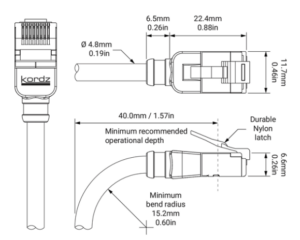
Kordz network patch cords are designed for integrators who need dependable performance, clean rack builds and durable construction. They feature a snap-proof latch design intended to withstand repeated handling in real-world rack and field conditions, and that matters because modern systems rely heavily on patching for access points, control systems, AV-over-IP equipment, surveillance devices and other PoE-powered electronics. A better twisted pair patch cable helps protect signal integrity, power delivery and serviceability.
>
The Bottom Line
Cheap fiber and twisted pair patch cables may save a few dollars upfront, but they can create expensive problems later.
A patch cable is a small component with a large impact. It can affect signal quality, PoE performance, network speed, optical loss, system reliability and customer satisfaction.
For professional installations, critical networks and high-performance residential systems, quality patch cables are not optional. They are part of building a system that works properly on day one and continues working long after the installation is complete.
When the system matters, the patch cables matter.
Learn more about quality patching products from LightSpeed Technologies, Cleerline, Kordz and other premium brands at FutureReadySolutions.com.
>