
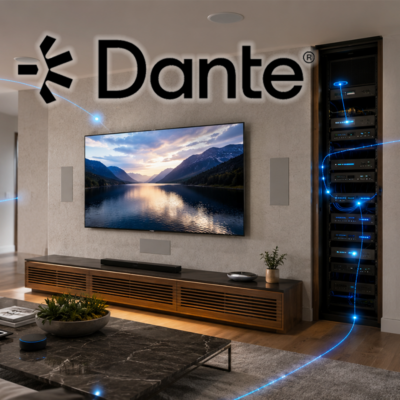
Modern homes are no longer built around a single TV, a pair of speakers and a basic receiver. High-end residential AV systems often include distributed audio, 8K home theaters, media rooms, outdoor entertainment areas, home offices, gaming spaces, guest houses, security cameras and whole-home control.
As these systems become more complex, traditional point-to-point AV wiring can become harder to manage. Every source needs to connect to every destination. Every room may need its own audio pathway. Every future change can require new cabling, new hardware or a major reconfiguration.
Dante offers a different approach.
Dante is a networked AV technology that allows audio, video and control signals to move over a standard Ethernet network. Instead of sending every AV signal through a dedicated analog, HDMI or speaker-level connection, Dante allows compatible devices to communicate over the home’s copper or fiber-based network infrastructure.
In simple terms, Dante lets residential AV systems behave more like a managed network and less like individual cable runs.
>
 Why Dante Matters in the Home
For many basic residential installations, traditional AV wiring still works well. A TV connected to a soundbar does not need Dante. A simple surround sound system in one room may not need Dante either.
Dante becomes more valuable when the home has multiple rooms, multiple sources, long cable runs or complex routing requirements.
For example, a large residence may have audio sources in a central equipment rack, speakers throughout the home, a dedicated theater, a home gym, an outdoor patio, a pool area and a guest house. In a traditional system, moving audio between those spaces may require a large amount of dedicated cabling and hardware.
With Dante, AV signals can be transported over the network, making it easier to route audio and video where they need to go.
>
Dante Benefits for Homeowners
For homeowners, Dante can provide several practical benefits.
First, it can make the AV system more flexible. Rooms can be reconfigured, sources can be shared and zones can be added more easily when the infrastructure is designed correctly.
Second, Dante can reduce visible clutter. More equipment can be centralized, keeping living spaces cleaner and more design-friendly.
Third, it can help support higher-performance systems. Digital signal transport over a properly designed network can be more scalable than traditional point-to-point wiring.
Finally, Dante can help future-proof the home. As more residential systems rely on IP-based technology, a strong network infrastructure becomes one of the most important parts of the home.
>
Benefits for Integrators
For residential integrators, Dante can simplify certain complex designs. It allows AV signals to be routed through the network, giving the integrator more options for system layout, source sharing and future expansion.
Dante can also help bridge the gap between residential AV and commercial-grade performance. As homeowners ask for better conferencing, better outdoor entertainment, better audio quality and more sophisticated control, networked AV tools become increasingly valuable.
However, integrators need to approach Dante with proper network planning. The best results come when the AV design and network design are developed together, not treated as separate systems.
>
Applications: Whole-Home Audio Distribution
One of the most practical residential uses for Dante is distributed audio.
In a larger home, audio may need to play in the kitchen, living room, bedrooms, bathrooms, outdoor spaces, garage, gym and pool area. A Dante-enabled system can move audio from centralized sources to multiple zones over the network.
This can be useful for outdoor entertainment, multi-zone listening and centralized source sharing.
Instead of treating every room as a separate isolated system, Dante can help tie the home’s audio zones together through the network.
>
 Applications: Home Theaters and Media Rooms
Dante is also be useful in dedicated theaters and media rooms, especially when the equipment rack is located away from the room.
In many custom homes, the AV receiver, processors, amplifiers, media servers and networking equipment are placed in a central rack. Dante can help move audio signals between the theater, rack and other equipment locations with less reliance on long analog runs.
For advanced theater systems, Dante may support cleaner signal routing between processors, amplifiers and other Dante-enabled components.
This can be especially useful when the theater is part of a larger whole-home AV system instead of a standalone room.
>
Applications: Outdoor Entertainment Areas
Outdoor AV can be challenging. Patios, pools, pergolas, outdoor kitchens, detached garages and sport courts may be far from the main equipment room. Long cable runs, electrical noise, weather exposure and future expansion all need to be considered.
Dante can help by using network infrastructure to move audio to outdoor zones. For larger properties, fiber optic links may be used between buildings, pool houses or remote equipment locations to extend the network and support AV distribution.
The key advantage is flexibility. Once network infrastructure is in place, it may be easier to add, reroute or expand AV endpoints later.
>
Applications: Guest Houses, Detached Buildings and Large Properties
Dante is particularly useful on large residential properties where AV needs to extend beyond the main house. Common applications include guest houses, pool houses, barns and workshops, detached garages and other outdoor remote structures.
In these applications, fiber optic cabling is often a strong backbone choice because it supports long distances, high bandwidth and electrical isolation between buildings. Dante devices can then operate across the network, allowing audio and potentially video to be shared between locations.
For example, the same music source used in the main home could also feed a guest house or outdoor pavilion. A microphone or paging source could be routed to different areas of the property. A video source could be distributed to multiple endpoints where Dante AV products are used.
>
Applications: Home Offices and Hybrid Work Spaces
Residential AV systems are increasingly supporting work-from-home environments. A high-end home office may include ceiling microphones, professional speakers, cameras, conferencing equipment and display systems.
Dante can be useful when the home office needs better audio quality than a typical webcam or USB speakerphone can provide.
For homeowners who regularly host video calls, record content or operate a business from home, Dante can bring commercial-grade AV capabilities into a residential environment.
>
Applications: Home Studios, Podcast Rooms and Music Spaces
Dante is widely used in professional audio environments, and some of those benefits translate directly into residential studios.
A homeowner with a podcast room, music studio, rehearsal space or production room may benefit from Dante because it can route high-quality digital audio between rooms and devices.
For example, a microphone in a recording room could send audio to a workstation in another room. A studio monitor system could receive audio from a Dante-enabled interface. A podcast room could share sources with a livestreaming setup or media rack.
For serious content creators, Dante can make a residential studio more flexible and professional.
>
Applications: Smart Homes and Centralized Equipment Racks
Many custom homes use centralized equipment racks. This keeps electronics organized, improves serviceability and reduces clutter in living spaces.
Dante works well with this design philosophy because it supports network-based signal transport. Instead of placing source equipment in every room, the integrator can centralize equipment and route AV signals over the network to the appropriate destinations.
This helps support cleaner room designs, less visible equipment, easier maintenance, better rack organization. more flexible source sharing and simplified future upgrades.
A centralized rack also makes it easier to coordinate networking, power protection, ventilation and cable management.
>
Dante and Video in Residential Systems
While Dante is best known for audio, Dante AV extends the concept into video. For residential systems, this may be relevant in homes with advanced video distribution requirements.
Video-enabled Dante applications include:
- Distributed video from centralized sources
- Media rooms with remote equipment racks
- Large homes with multiple displays
- Home offices and conferencing spaces
- Training rooms or presentation spaces inside the home
- Guest houses or detached entertainment areas
However, Dante AV is not always necessary for typical residential video. Many homes still use HDMI extenders, HDBaseT, AV-over-IP platforms or direct HDMI connections. The right approach depends on the number of displays, source locations, desired resolution, latency requirements, network design and budget as we’ll see below.
>
Is Dante Right for Every Home?
Dante is not necessary for every residential AV project. It may be unnecessary for a single TV installation, a basic media room, a simple soundbar system, a small distributed audio system with limited zones and budget-focused installations where traditional wiring is simpler.
Dante makes the most sense when the system is larger, more sophisticated or expected to evolve over time.
>
The Dante Infrastructure
Dante depends on the quality of the network behind it. In a residential system, that means the cabling, switches, terminations and network design must be planned carefully.
The proper Dante infrastructure must have quality network cabling with proper terminations, managed network switches with adequate bandwidth, power over ethernet (PoE) and an installation team that understands advanced networking.
True, Dante can make AV systems more flexible, but it does not make the physical infrastructure less important. In fact, the network becomes the foundation of the AV system.
A poorly designed network can create dropouts, latency, discovery issues and difficult troubleshooting. A well-designed network can make the system more reliable and easier to expand.
>
Final Thoughts
 Dante brings professional networked AV capabilities into residential environments. While it may not be needed for every home, it can be extremely useful in larger, more advanced systems where flexibility, scalability and centralized design matter.
For whole-home audio, home theaters, outdoor entertainment areas, guest houses, home offices and residential studios, Dante gives integrators another way to move high-quality AV signals throughout the property.
The most important thing to remember is that Dante is only as reliable as the infrastructure behind it. Quality cabling, proper network switches, clean terminations, thoughtful design and thorough testing are essential.
As residential AV continues to move toward IP-based systems, Dante is a technology worth understanding. For the right home, it can make the AV system cleaner, smarter, more flexible and better prepared for the future.
Future Ready Solutions and AVPro Edge offer a power suite of Dante-enabled products. Learn more at FutureReadySolutions.com.